
We’ve traveled 700nm North from where we started in October with the following strategy:
Wait for favorable weather then run North to a safe spot and wait for the next weather window. Note that I used the word ‘safe’ and that is literal. Winter winds in the Sea of Cortez can be quite strong and the waves with the strong wind are short and steep. We knew there were some strong winds coming when we arrived in Santa Rosalia and the wind did not disappoint. Gusts were well above 40kts at times and coming from an angle into the marina that was, at times scary. Everyone in the marina including us were out checking and double-checking dock lines and hoping that the dock stayed together. When the wind blows like that in a marina all the rigging on the sailboats makes a noise like a distant monster howling.
It got so chilly a couple of weeks ago we swapped our light bedding for a down comforter. In the mornings, we turn the diesel heater on to take the chill off the boat. We’ve both been running around with several layers of clothes on. Three blocks from the marina we’re peeling the layers off because sheltered from the wind we suddenly get hot!
Santa Rosalia is a lovely little town of 14,000 people. The town almost appears untouched by tourism. The marina is very small with space for only 20 boats. The town was formed in the 1800’s as a copper mining ‘company’ town, originally operated by El Boleo, a French mining company. There is evidence of French influence in architecture and mining operations all over town. Santa Barbara catholic church was designed by Gustave Eiffel and shown alongside the Eiffel tower in Paris. Miners were demanding a place to worship in town and the mine operators purchased the (mostly sheet-metal) church in France, disassembled it, boxed it up, and put it on a ship it to Santa Rosalia where it was reassembled and still stands today.
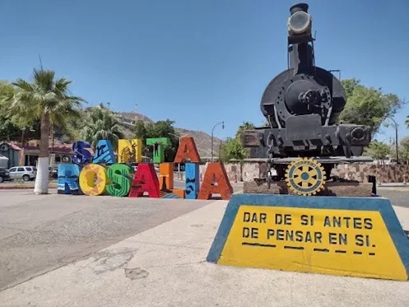
Numerous buildings and old factories stand as witness to the town’s industrial past. Old cranes, mining carts, a steam locomotive as well as glassy copper refining slag. The harbor is constructed almost entirely of huge lava-like blocks of slag. Many of the town’s buildings were originally parts of the mine operation. Now Santa Rosalia sits on Mexican Highway 1 on the Baja peninsula where a steady stream of RVs, trucks and personal vehicles move all day long.
In August 2025 Santa Rosalia was hit by hurricane Hillary which caused significant damage. There is still evidence visible today of the destruction. The Mexicans are resilient and immediately started rebuilding and repairing their town the best they could.
Although Santa Rosalia is not particularly touristy, we quickly found that it has great tacos and a wonderful bakery (El Boleo Bakery) that we visited almost every day. The rotating selection of Mexican and French style pastries kept us well supplied.
Still after enduring quite a lot of wind for about a week it was time to move on. We’ll take advantage of some light Southerly winds – unusual this time of year, and sail across the Sea of Cortez to San Carlos, about 75nm.
Leave a Reply