
After waiting out the Northerly winds for 9 days we finally got a weather window so we could leave the protected anchorage at Puerto Escondido. Our plan is to cruise North to Santa Rosalia. Today we’ll go 38 NM and drop anchor for the night at Caleta San Juanico known for its protected bay and sharp pinnacle geological formations.
It’s actually been relaxing being stuck in Puerto Escondido. It’s a very modern marina with lots of nice amenities. We had time to learn to play cribbage. In the evenings if we’re not watching movies or listening to live music at the marina restaurant we play a competitive game of cribbage.
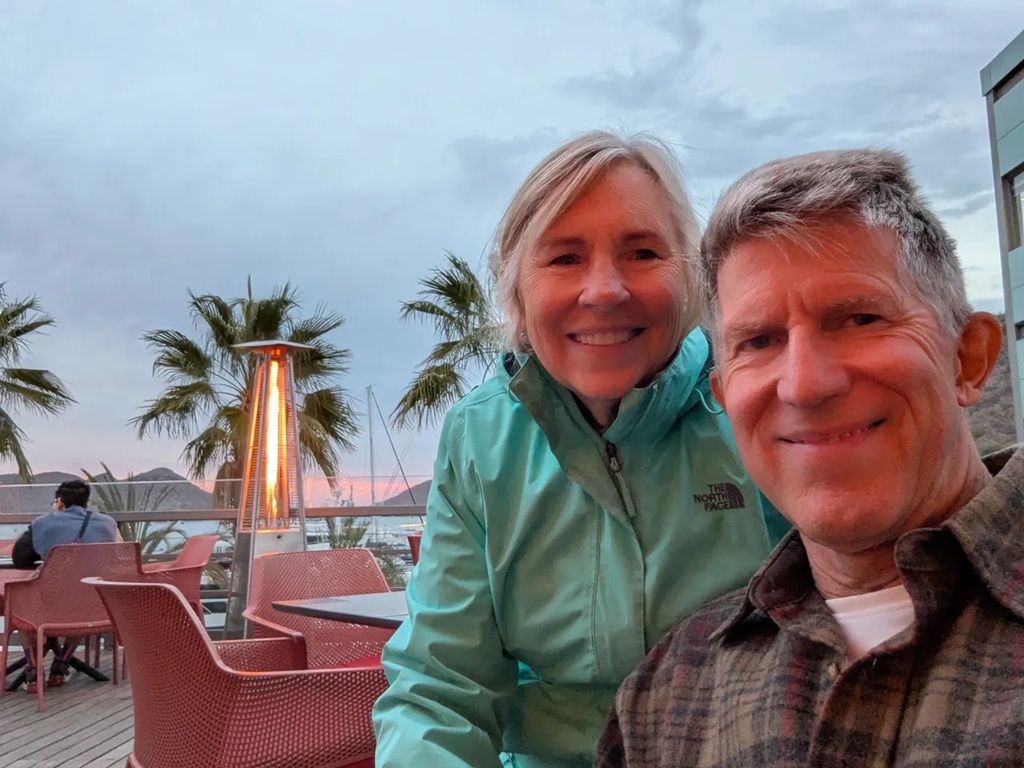
As you can see in the photo above we are bundled up as the sun is setting. It’s always beautiful here but the Northerly winds are cool and the dessert is cold at night this time of the year. Thankfully, the outdoor restaurant has heaters in the winter.
One of the things we wanted to see when in Loreto was a 325 year old mission at San Javier (the full name is Mission San Francisco Javier de Vigge-Biaundo). It’s up in the hills above Loreto. The directions to find it were to use Google maps but to be sure to download the maps for offline use since the area is beyond cell service. Getting there would involve a rental car. The ladies in the marina office were very helpful and Ventur Car Rental delivered a car to the marina. We got it for 24 hours and the price was less than a round trip cab to the airport! Now we get to drive on Mexican roads again! We’re a little captive at Puerto Escondido. There’s one restaurant and while it’s a pretty place, getting out and about is exciting. We drove to Loreto to recharge our Peso supply at a cash machine then headed up in the hills. The road is winding and narrow, dotted with shrines for past traffic fatalities. At the end we arrived at a small town of 200 residents with the mission. It’s interesting to see how Spanish colonialism reshaped the culture of North America. Along with the church there were orange trees and olive trees (one of the olive trees is as old as the church!). All of this is possible because of two springs that feed water from the mountains to this tiny town and its church!
After returning to Loreto, we decided to do some grocery shopping. Grocery shopping is always a challenge. To their credit, Mexicans cook from scratch and use different ingredients than we’re used to. On the Baja peninsula, food is ferried from the mainland and trucked to stores but not every day. So it can be hard to find what you want or all the ingredients for a recipe you were planning to make! We went to three stores and finally found most of what we needed. One of the stores – El Pescador “the fisherman”, seemed to be the store that caters to expats and sells (expensive) American brands. For the first time in Mexico we saw our favorite La Victoria hot salsa. YAY!
The day before we left Loreto, Ricardo, the outdoor director at the marina (fishing guide, hiking guide, scuba diving guide, and immigration lawyer) took us on a hike up into the Tripui Hills. It was a beautiful hike with numerous indigenous plants along the trail and incredible views of the islands and mountain ranges. Ricardo’s wife, Gabriella, is the Spanish/English teacher, yoga instructor, mid-wife, fill-in waitress for the restaurant, and snorkeling guide for the marina. People in Mexico wear many hats!
Leave a Reply