
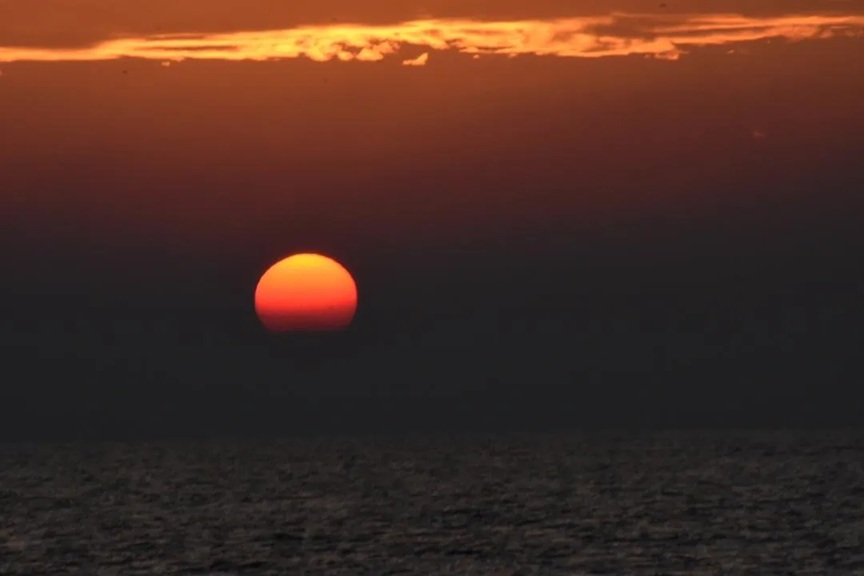
We left Mazatlan Nov.14th with a 72 hour weather-window to complete our 200 NM trip to the Baja Peninsula. This means the boat has a day shift and a night shift and we’re the crew for both. Neither of us likes staying up all night but we have to work something out so we take turns (usually 4 hr. shifts) while the other sleeps. Happily we were traveling under the last super-moon of the year, a so called “Beaver Moon”…lol. It’s pretty dramatic as the sun sets off one horizon and the full moon rises off the other horizon. The moon is so bright that it casts shadows in the cockpit of the boat.
As it gets dark we both start to feel very small. In the middle of our crossing we were nearly 100 NM from either shore. From time to time during our trip we could see the Baja ferries in the distance. If they knew we were there, they must have wondered how we were creeping along compared to them. We averaged maybe 5-knots while they make the trip overnight at18-knots. As we traveled West the water gradually got more blue and clear as we moved from the Pacific into the Sea of Cortez which is distinct from the Pacific in just about every way.
We started to see flying fish and kept our eyes out for flying Mobula Rays (although sadly we didn’t see any). By the end of the first day it had become pretty clear that the weather window had shrunk from 72 to 48 hours. We decided to continue past our first anchorage opportunity at Ensenada de Los Muertos (the Bay of the Dead – I love the name!) and continue to La Paz. The huge anchorage there is somewhat sheltered from the Northerly wind and more importantly from the waves that sweep down the 600 NM length of the Sea of Cortez. When we got to La Paz our first order of business was to take boat-dog, Riley, to shore. As much as we’d tried to coax him with treats he refused to use his tiny piece of artificial grass on the boat. Poor little guy – 48 hours is a long time! After that, time to take a good nap!
In 2022-2023 we were ‘stuck’ in La Paz from November to March getting our stainless steel davits and solar arch fabricated. It’s a familiar place to us and we enjoy it but we have NO plans to stay that long this time. A little surprising to us this time is how much cooler it is. Compared to Puerto Vallarta, it’s much drier and cooler.
To take a break from walking the Malecon in La Paz we rented a car and took a trip to a town called La Ventana (“The Window”). Situated in a channel with Isla Cerralvo a few miles off shore the prevailing wind blows down the beach steadily most days and provides one of the best places in North America to participate in wind sports. Take a kite/sail/wing and pair it with a board or a foil-board and you have kite-foiling, kite-boarding, kite-surfing, wing-boarding, wing-foiling, etc. We watched all the activity from the roof top bar of the wind-sports school with cold Pacificos.
Driving in Mexico is not for the faint of heart. I think generally drivers in Mexico are VERY courteous and respectful of pedestrians but the rules are just different enough to be jarring. Stop signs are purely a suggestion. There is no formal driver training, (I think you just go pay for a license). If there’s an accident you may be expected to settle up right there. There are stories of police stopping rental cars for a bribe (our car had a convenient “AVIS” sticker on the back). Luckily, we didn’t get pulled over.
Usually it’s not recommended to drive after dark outside the city since free range cattle are grazing and may be in the road. On our 30-ish mile trip, we saw groups of cattle along the road and drivers generally put on their 4-way flashers to warn oncoming traffic. Crosses and small shrines at sharp corners and drop-offs next to the road are a regular reminder to keep your eyes on the road.
The roads are narrow, no shoulders or guard rails and very few signs. Making sure we got back before dark, we made a final stop at the grocery store experiencing the wonderful luxury of putting our groceries in a car instead of the folding wagon that we usually have! Then it was off to return the car.
Now that we have provisioned and our laundry has been done at the lavenderia for us (the laundry is not self-service), we are ready to depart La Paz on Saturday if the port remains open. The port closes once the winds reach 18 knots. It’s been closed the past few days. You know the status by the color combination of flags they fly at the marina. Blue & Yellow flags mean the port is closed. When it’s closed, you are allowed to enter from the sea but you cannot leave the port once inside the harbor. If you do, you are fined $10,000 USD at your next port of call. Wise sailors only depart when the port is open and the weather is favorable.
Leave a Reply