
Living on the boat for the last two weeks has been interesting, to say the least. I’d never spent more than a day or two on a sailboat, so I’m hoping to give a bit of an outsider’s perspective on boat life. I’ve been eagerly watching Island Summer’s journey since my parents first started provisioning the boat a few years ago, and I’ve always been intrigued to find out what it’s like to live on a sailboat.
One thing that’s struck me is just the sheer amount of things that you have to pay attention to. As we came into the anchorage of Isla Isabel from San Blas, we got a warning call over the VHF radio telling us there were quite a few fishing nets we’d need to avoid coming in, and we pulled up the binoculars to take a look. The island was absolutely inundated with a labyrinth of fishing gear that we had to navigate around, and hitting any of it would have required diving under the boat to disentangle it from the keel and rudders and then dealing with an angry fisherman whose nets we’d just destroyed. Needless to say, we had to take it slow and steady to navigate in, which is much easier said than done with a 44 foot sailboat.
Once we got in, it was quite late and we dropped anchor for the night on what was supposedly a rocky bottom. I couldn’t figure out why this was causing my dad so much anxiety and said to him, “What’s the worst that can happen? So what if our anchor drags a bit?” After thinking about the answer to that question and looking over at the enticingly sharp rocks not more than a few hundred feet off our bow, the reality of the situation set in for me. If the anchor gave way while sleeping, we could wake up to the boat crashing up against the rocks or some other calamity. I stopped hard timing him after that, but nonetheless woke up in a bit of a mild panic when an alarm started going off at around 2 AM. While initially thinking it was our anchor alarm (we set up a GPS system to notify us if we move too far from the anchor point), it was thankfully just the autopilot system that got left on trying to tell us that we were somehow off course. Nonetheless, this was not the most restful night’s sleep I’ve had.
The next day, we loaded up the dinghy and went for a small hike around the island. It’s a pretty small island that has a small fishing camp of about 10-15 people living there in some semi-permanent wooden shacks. As we were pulling the dinghy onto shore, a kid ran over to us and started talking with us immediately in very fast Spanish. We eventually figured out that he was telling us that we needed to pull the dinghy higher up on shore because the tide was coming in.
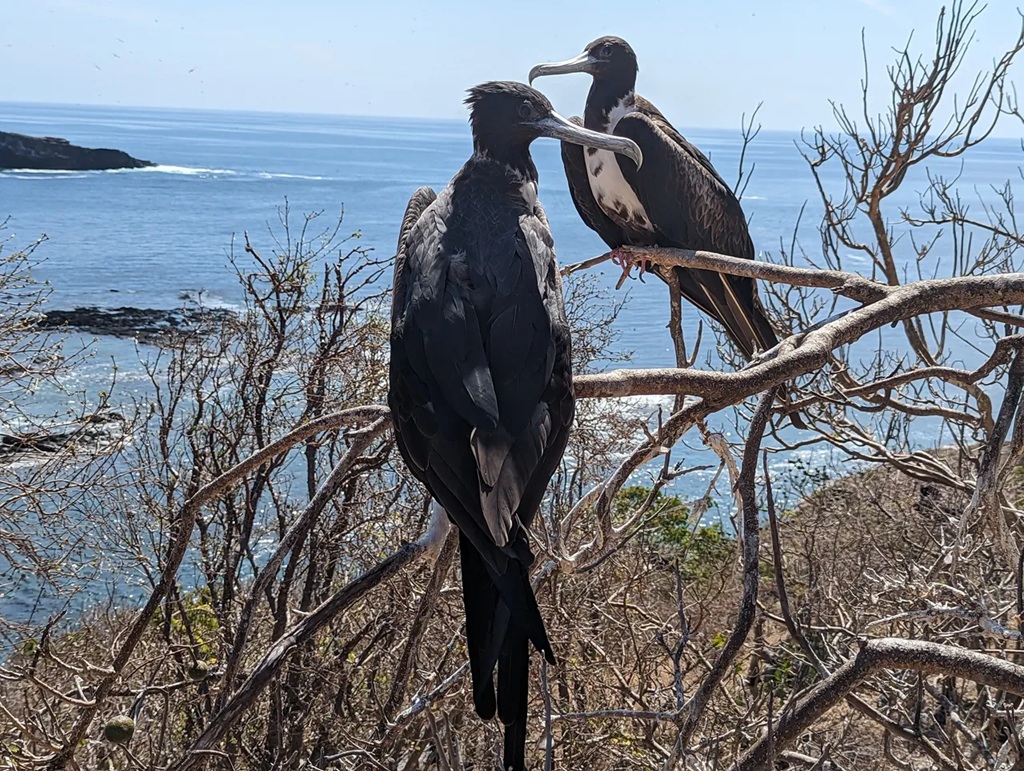
As we started our hike along the path to the island, the kid started telling us that there were also native Mexican milk snakes on the island that we should be aware of, and was pantomiming fang bites into his arm. We think he was telling us that they aren’t venomous, but we weren’t sure. It set the tone for the rest of our time on the island nonetheless. Stepping into the brush was like stepping into another world – the whole island is a national park because of all the seabirds that nest there, and also has an abundance of iguanas and other wildlife. Because the birds have no natural predators on the island, you can get up close and personal with the frigate birds – and they certainly feel much bigger when you’re facing them down eye-to-eye less than a few feet away. The sheer amount of wildlife was overwhelming. The second we stepped into the brush, we heard the constant calls of seabirds, both in nests and flying in the air, and the bushes felt absolutely alive as iguanas fell out of trees and scurried through the underbrush. The brush was so thick that it was hard to shake the paranoia that a Mexican milk snake was lying in wait – they’re supposedly quite large snakes, and I had no desire to see one.
After our visit to the island, we set out for an overnight sailing trip from Isla Isabel to Chacala – I wanted the full sailing experience, even if we probably didn’t have to sail overnight if we didn’t want to. My dad brought out the offshore life jackets and harnessing gear, which I initially thought was overkill. Why did we need all this stuff when we’ve been sailing all over the place without it so far? When the sun set, I quickly realized why. The sheer darkness around you is absolutely pervasive when there’s no source of light for 30 miles in any direction and you’re surrounded by nothing but ocean. While you can hear the surf around the boat, it’s actually quite hard to see it, and your world shrinks down to just a handful of square feet in the cockpit of the boat. It almost felt like being on a spaceship, and we were all a bit on edge because a boat similar to ours had disappeared without a trace near where we were sailing just two weeks prior. While mildly terrifying at times, it was incredibly peaceful watching the stars and listening to the wind and waves push us along.
Living on a boat has been a fascinating experience – everything takes more time and effort. Taking our dog Riley for a walk suddenly requires us to put the dinghy into the water and motoring to shore, and the whole effort often takes nearly an hour. Similarly, things that you take for granted in day to day life start requiring a ton of attention to detail. When you’re taking a shower, you’re bracing against the walls as the boat rocks in the waves and using as little water as possible because there’s always a limited supply. Whether it’s monitoring the battery or water levels, it feels like there’s always something that needs to be taken care of, and every decision you make is some form of tradeoff. Sure you can take a nice long shower, but then you need to run the water maker for hours offshore and have to take care of how much power you have available. It’s a one of a kind experience that’s hard to put into words – it almost feels like everything is hanging in a delicate balance at all times, and you need to be careful to keep it that way. It gives me a newfound appreciation for a trip around the world that I’ve had stuck in my mind since I was a kid 15 years ago completed by Jeff, Casey, and Matt (many of whom have been featured previously on this blog). I’d definitely recommend giving it a try if you ever have the opportunity 🙂
While life is a little harder, the opportunities are astounding – Isla Isabel is a place that very few people ever have the opportunity to visit, and I would have never gone out of my way to see it otherwise. But it was absolutely incredible to observe places that are generally well off the beaten path and get a sense of what life is like outside of the tourist destinations.
Leave a Reply